On knowledge, curiosity, judgment, and why knowing how to use the right tool may matter as much as knowing the answer.
This will probably piss some people off.
Not because I think AI will change education. That part is already obvious.
The part that may bother people is that I believe some of what old-school education views as cheating today may become a valuable skill tomorrow.
Using outside information. Asking a tool for help. Starting with something another person or system created. Getting assistance organizing your thoughts. Combining resources instead of solving everything alone from memory. Using technology to complete part of the work faster.
In many classrooms, those things can disqualify the work.
In much of adult life, they are called being resourceful.
And if my daughters are nothing else, I hope they are that. I hope they can walk into an unfamiliar situation, understand what is needed, and find a way to bring value.
I should say upfront that I have no qualifications to preach about education. I am not a teacher, researcher, administrator, or policy expert. I am a dad with two young daughters, thinking about what I hope they learn as the world changes around them.
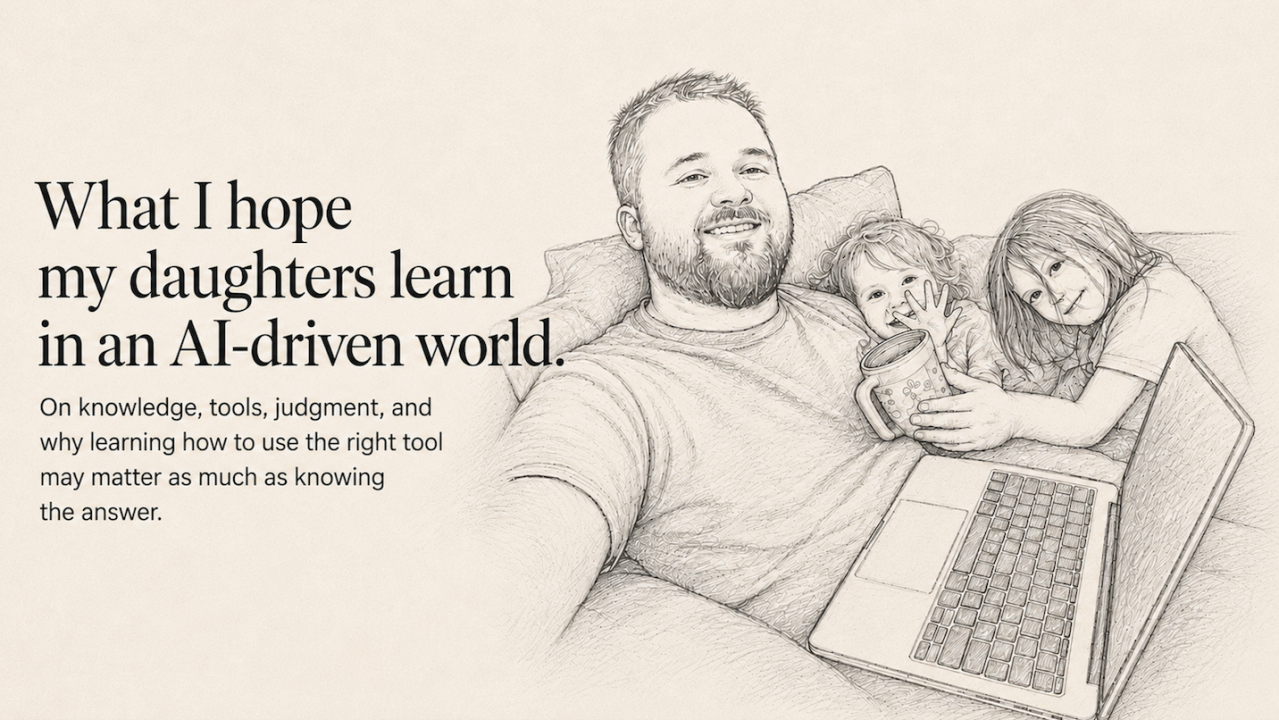
Right now, they are still young enough to climb onto the couch beside me while I am working, press buttons they should not press, and ask questions faster than I can answer them. They do not understand what AI is. To them, the laptop is just another object in the room, somewhere between a television, a coloring book, and whatever Dad is tinkering with that day.
By the time they are old enough to choose a major, trade, career, or another path, AI will probably feel ordinary to them.
I do not spend much time wondering whether they will use it. They almost certainly will.
I wonder whether they will understand how to use it without letting it do all of their thinking for them.
What my education taught me
My perspective comes mostly from my own experience.
When I completed my MBA, I thought I was the smartest person on the block. Most people in my family had taken different paths. Some went into trades. Others built careers through experience instead of advanced degrees.
I had gone further through the traditional education system, and part of me treated that as proof that I had reached a higher level.
The reality was that the people around me were already successful in their own right. They knew how to build and fix things, manage money, operate businesses, solve real problems, and make good decisions. They did not need a graduate degree to validate their capability.
I still value my MBA. It gave me useful knowledge, broader context, and an experience I am glad I had.
But the actual content I learned during those years probably accounts for less than 10% of what I rely on today.
Most of the rest came from facing problems I had never seen before, asking for help, learning from people who knew more than me, making mistakes, developing judgment, and teaching myself what I needed to understand next.
That does not make formal education unimportant. It makes me question whether completing a curriculum and becoming truly capable are always the same thing.
Education should provide a foundation without defining a ceiling. It should build knowledge, confidence, curiosity, and enough self-awareness to keep progressing long after the structured instruction ends.
It should also help students build a problem-solving toolkit made up of more than facts and formulas. They need ways of approaching unfamiliar situations and an understanding of which tools, people, and resources can help move something forward.
That education continues through work, relationships, responsibilities, failure, parenthood, and problems that do not come with an answer key.
AI is one tool in the toolkit
I grew up in a rural coal-mining town and a blue-collar community where people built their lives through practical skills, hard work, and showing up for one another.
Since then, I have been fortunate to work alongside people with very different backgrounds, from small-business owners and operators to senior executives and extremely talented data and development engineers.
I do not mention that because proximity to accomplished people makes me an expert. It does not.
I mention it because I have seen that capability takes many forms.
The people who stand out are rarely the ones who seem to have every answer memorized. They are the ones who know what to do when they do not have the answer.
They recognize problems before someone assigns them. They know which questions to ask, who to involve, where to look, what to test, and which tools might help.
Over the past few years, AI has increasingly become one of those tools.
The people using it well are not simply typing questions into a box and copying whatever comes back. They use it to explore data, prototype ideas, build software, create workflows, pressure-test strategies, automate repetitive work, and turn rough thoughts into something tangible.
I regularly keep an AI tool open alongside my own work. I use it to organize scattered ideas, connect information across different areas, challenge assumptions, and turn something vague into a first version I can inspect.
I do not treat it as an authority or hand it responsibility for the final decision. I give it context, challenge what it produces, try different directions, and decide what is actually useful.
That is the important distinction.
The value is not simply having access to AI. It is understanding where AI belongs in the process.
That is also where the education debate becomes more complicated.
A lot of the conversation begins with one question: How do we stop students from cheating?
I understand the concern. A student can ask AI to write an essay, copy the response, submit it, and learn almost nothing. That is cheating because the tool replaced the thinking the assignment was intended to develop.
But not every use of AI belongs in that category.
A student could use it to explain a difficult concept in several ways until one finally clicks. They could challenge an argument, generate practice problems, compare perspectives, outline an experiment, or identify gaps in a project.
They could move from an idea to a prototype, presentation, survey, model, or basic piece of software, then test it, improve it, and explain what they learned.
The student still has to decide what they are trying to accomplish. They have to make choices, evaluate tradeoffs, correct mistakes, and determine whether the result works.
That is not simply asking AI for an answer. That is constructive tool use.
This is where my hot take comes in: some of what old-school education calls cheating may eventually become a core part of being educated.
Not because doing the work no longer matters, but because knowing how to use the resources around you will become part of the work.
We have seen smaller versions of this debate before. Calculators were viewed as shortcuts. The internet was treated as a less legitimate way to research. Spellcheck, online tutorials, and educational videos were criticized because they made parts of the process easier.
Many of those supposed shortcuts eventually became normal parts of how capable people work.
AI is a much larger leap, and the risks are greater, but the underlying question is similar.
Is the student using the tool to expand their thinking, or to avoid thinking?
Those are not the same thing.
Becoming a master craftswoman
For my girls, I think about it like becoming a master craftswoman.
A master craftswoman is not valuable because she completes every job using only a hammer. She is valuable because she understands the work well enough to know whether it requires a hammer, saw, drill, level, measuring tape, another person’s expertise, or something more specialized.
She understands the fundamentals. She knows when a tool will improve the result and when the wrong tool could create a larger problem. She knows when the work requires patience, precision, outside help, or starting over.
She also understands that owning a tool and mastering it are not the same thing.
Anyone can buy an expensive tool. That does not make them a craftsperson, although that is more or less the argument I gave my wife when I wanted another impact wrench from Lowe’s last week.
Anyone can open an AI tool and enter a prompt. That does not mean they understand the problem, know how to guide the work, recognize a strong result, or know what to do with the output.
AI is not the craft. It is one tool in the workshop.
Sometimes it may be the best tool for the job. Sometimes another technology, another person, direct experience, a book, a spreadsheet, or simply sitting down and thinking will be better.
Sometimes the right decision will be to put the tools down, get your hands dirty, and learn through the work itself.
Someone who automatically uses AI for everything is not demonstrating mastery. Neither is someone who refuses to use it because receiving help feels impure.
The master craftswoman knows when it belongs in the process.
That requires judgment. You have to understand the problem, choose the right resource, recognize what must be done personally, and test whether the outcome actually works.
It also requires honesty.
Is the tool making me more capable, or is it helping me avoid developing an ability I still need?
That question matters for AI, but it also applies to almost every resource we use.
There is another part of capability that matters just as much, understanding your own mind.
The formal term is metacognition. I think of it more simply as knowing yourself well enough to use your mind effectively.
Do I really understand this, or do I just recognize the words? What kind of explanation helps something click for me? Do I learn best by reading, discussing, watching, testing, or building? Where am I naturally strong, and where do I need practice or another person’s perspective?
It also means knowing the difference between confidence and understanding.
Am I certain because I have worked through the problem, or because I have not yet realized what I do not know? Am I using a tool because it improves my work, or because it offers the easiest path?
Formal education only took me so far in that area. A degree gave me knowledge and structure. It did not automatically teach me to recognize my blind spots, manage uncertainty, admit when I was wrong, or understand what kind of work gave me energy.
Those lessons came later through experience, failure, relationships, and watching capable people operate.
They also came through becoming a husband and father, where being technically correct is not always the same as being helpful, patient, or present.
I do not only want my daughters to become effective problem-solvers. I want them to become thoughtful people.
I want them to understand that not every problem is theirs to fix, not every conversation requires an immediate answer, and not every part of life should be optimized.
Sometimes the best thing you can bring to a situation is not speed or intelligence.
It is attention.
What I hope they carry with them
None of this means knowledge should disappear from education. A craftswoman still needs to understand the craft.
Students need foundations in reading, writing, math, science, history, and other subjects. Without them, they may not recognize when AI, or any other source, gives them a bad answer. They may not have enough context to ask useful questions, evaluate the work, or build anything meaningful.
Knowledge matters, but it should be the foundation rather than the finish line.
Sometimes students should complete work without AI so they can develop a foundational skill. Other times, they should be expected to use it constructively, investigate a problem, create something, test it, revise it, and explain the thinking they contributed.
The appropriate tool depends on the learning objective.
If the goal is basic writing ability, having AI produce the entire essay defeats the point.
If the goal is developing a persuasive argument, using AI to challenge the reasoning, identify weak evidence, and test it against different audiences could deepen the work.
The same behavior can be cheating in one context and an expected skill in another.
Copying an answer you do not understand is cheating. Using a tool to pressure-test your answer may be good judgment.
Turning in something AI created while pretending you created it is dishonest. Using AI to build a prototype, then explaining the decisions, failures, revisions, and lessons may demonstrate more understanding than a traditional paper.
The presence of the tool does not determine whether learning occurred.
The student’s contribution does.
The world my daughters will enter will not ask them to prove they can solve every problem alone, without information, assistance, or tools. It will ask whether they can solve the problem and whether they can be trusted to understand what they are doing.
I want them to face something they have never seen before and figure out what comes next.
I want them to recognize problems before someone hands them an assignment and know how to move from curiosity to research, from research to an idea, and from an idea to something they can test.
I want them to know when technology can help and when the better answer is to call someone, read more, practice the skill, get their hands dirty, or slow down and think.
I want them to experience the satisfaction of creating something they could not create before, not because AI did everything for them, but because they combined their knowledge, curiosity, judgment, relationships, and tools to make it possible.
Eventually, they will also need to decide which tools deserve their time, money, and energy. A master craftswoman does not invest equally in every tool in the hardware aisle. She invests in the tools that match the work she wants to do.
Some technologies will be temporary trends. Some will become everyday utilities. Others will become central to the field or craft they choose.
AI will be part of that toolkit, but it will not be the whole toolkit.
Most importantly, I want my daughters to understand themselves well enough to know what kind of work and life they want to build.
That may lead them toward a college degree, a trade, or a career that does not exist yet.
The specific path matters less to me than whether they learn how to keep learning, solve meaningful problems, treat people well, and pursue something that gives them purpose.
That is why I think we will eventually need a better definition of cheating.
The question cannot simply be whether a student used AI. We should ask whether they understood the problem, chose the tool intentionally, verified the information, recognized where it failed, and could explain the decisions that shaped the work.
Did the tool expand their ability, or did it replace the part of the process they needed to practice?
A master craftswoman is not defined by the most advanced tool in her workshop. She is defined by her understanding of the craft, her judgment about what the work requires, and her ability to bring the right tools together to build something worthwhile.
That is what I hope my daughters learn.
I want them to be curious without being afraid of what they do not know. Confident without believing they have nothing left to learn. Resourceful enough to find a way forward, but humble enough to ask for help.
The point is not the tool.
The point is what they are able to learn, build, contribute, and become.
And the most important tool they will ever learn to understand is still their own mind.
Originally published in a shorter form on LinkedIn.